
Here we give you some ideas what you can do with the dynamometer mathematical channels. These are just a few, so use your creativity and create your own, what ever helps your tuning!
For the calculations you can use + – / x and %
You can also loop the calculations, create one calculation first and then use the result in another calculation.
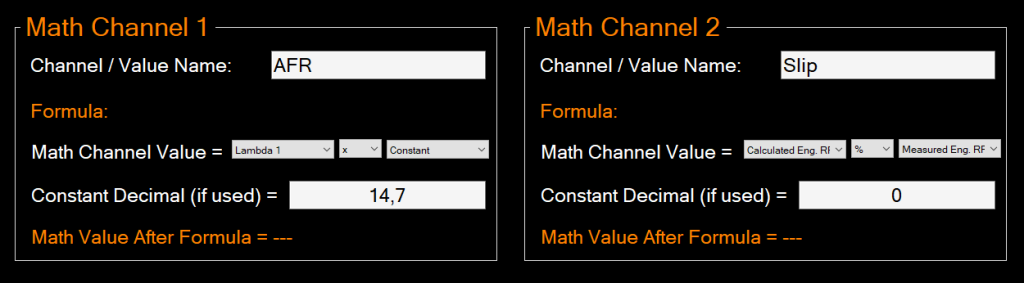
AFR
Formula: Lambda x Stoichiometric constant (14,7)
AFR describes the ratio between the mass of air and fuel entering the engine. For petrol engines, the stoichiometric air-fuel ratio is 14.7:1, meaning 14.7 kg of air is required to completely burn 1 kg of fuel.
By multiplying the measured lambda value by 14.7, you convert lambda into AFR.
Torque converter slip
Formula: Calculated Engine RPM % Measured Engine RPM
With a car that has torque converter you might want to know how much it is slipping. Take the Calculated Engine RPM, derived from the dyno calculated through hub speed and ratio and Measured Engine RPM that we get when measuring it with Plex Knock Monitor.
Intercooler pressure drop
Formula: Pressure before cooler – pressure after cooler
With this calculation you can see how much boost pressure is lost with the intercooler.
Knock count
Formula: Knock level – Knock threshold
When using Plex Knock Monitor, you can create this math channel to tell if the engine is knocking, just use Knock level and Knock threshold, and you’ll see if the level goes above the threshold.
Boost
Formula: Map – Baro
To rule out the barometric pressure and look at the boost only.
Effective fuel pressure / pressure differential
Formula: Absolute fuel pressure – Manifold pressure
The actual pressure that is pushing the fuel out of the injector. Important with boosted engines and helps you diagnose fuel system limitations.